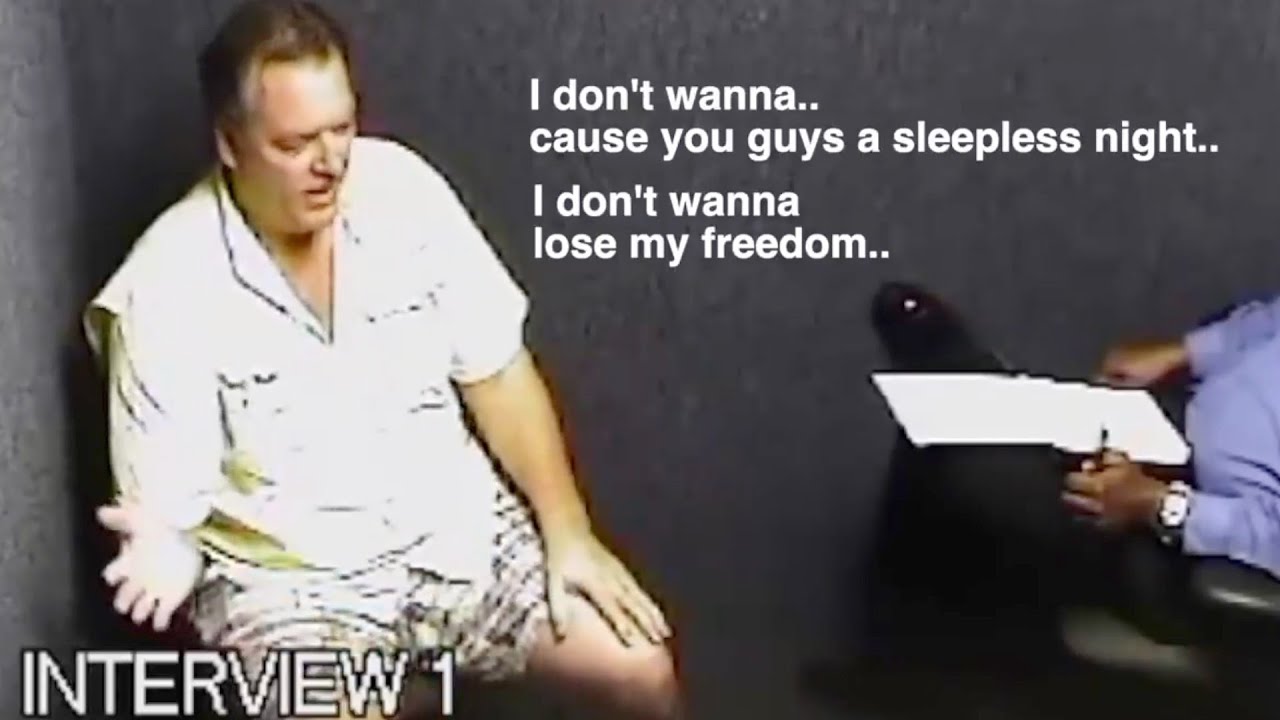
Watch the video on YouTube: “The Case of Michael Dunn” by JCS - Criminal Psychology
JCS's Michael Dunn Video: An Interrogation Built Around a Weapon That Wasn't There
On November 23, 2012, Michael Dunn pulled into a Jacksonville gas station next to an SUV carrying four teenagers. Minutes later he had fired ten rounds into that SUV, and 17-year-old Jordan Davis was dead. In the interrogation that followed, Dunn's entire defense rested on one claim: that Davis had pointed a shotgun at him. No shotgun was ever found.
That gap — between the weapon Dunn described and the evidence investigators actually had — is the engine of this video. JCS, the channel that effectively defined the modern interrogation-breakdown format, works through the interview, a recorded jail phone call and Dunn's later trial testimony, comparing each version of his account against the others and against the physical record.
The video, published in February 2020, has pulled in more than 17.8 million views. It is one of the channel's defining case studies: less a whodunit — Dunn never denied firing the shots — than an examination of how a self-defense claim is constructed, and how it comes apart.
At a Glance
| Video | “The Case of Michael Dunn” |
|---|---|
| Channel | JCS - Criminal Psychology |
| Published | February 20, 2020 |
| Length | ~57 minutes |
| Views | 17.8M+ |
| Subject | The 2012 killing of Jordan Davis in Jacksonville, Florida; Michael Dunn's interrogation and self-defense claim |
What the Video Covers
The video opens with a recorded jail phone call between Dunn and his fiancée, Rhonda Rouer, in which Dunn presents himself as the victim of the encounter — a framing the rest of the video tests. It then reconstructs November 23, 2012, in Jacksonville, Florida: Dunn and Rouer, returning from his son's wedding, stopped at a Gate Petroleum gas station and parked beside a red Dodge Durango. Inside were four teenagers — Tommie Stornes, Leland Brunson, Tevin Thompson and, in the back seat, Jordan Davis — listening to loud music. Dunn asked them to turn it down; they did, briefly, then turned it back up, and Dunn and Davis exchanged angry words.
What happened next is not in dispute. Dunn took a handgun from his glove compartment and fired ten rounds into the SUV, striking Davis three times. The other three teenagers survived. Dunn then left the scene with Rouer, returned to their hotel, and never called the police; the next day the couple drove home, where Dunn was arrested. No weapon was found in or around the teenagers' vehicle. In his interrogation, Dunn insisted he had acted in self-defense — that he had heard threats and seen Davis raise what he described as a shotgun and begin getting out of the SUV. The detectives stay neutral and let him talk at length, and the video lingers on what that produces: a shifting description of the supposed weapon, dramatic pauses, and a detailed account that investigators could not match to the evidence — including forensic indications that Davis's door was closed when the shots were fired.
The final section moves to the courtroom, where Dunn's testimony added vivid detail that had not appeared in his interrogation, and where it emerged that he had never told Rouer — that night, at the hotel, or on the drive home — that the teenagers had a gun. The video closes with the outcome: at his first trial in February 2014 Dunn was convicted of three counts of attempted murder and of firing into an occupied vehicle, while the jury deadlocked on the murder charge; at a second trial that October he was convicted of the first-degree murder of Jordan Davis and sentenced to life in prison without parole, in addition to the long terms from the first trial. His appeal was denied in 2016.
Strengths
Three recordings, one comparison. The video's real method is juxtaposition: the jail call, the interrogation and the trial testimony are placed side by side, so viewers can watch details appear, change and disappear across Dunn's own tellings. It is a more persuasive structure than narration alone could be.
The detective work is shown, not summarized. The interviewers stay flat and non-confrontational, encouraging Dunn to commit to specifics — and it is those specifics, freely given, that the evidence later contradicts. The video explains why that patience matters instead of treating the interrogation as a shouting match.
It keeps the central fact in view. Whatever Dunn believed in the moment, a 17-year-old who had no weapon died in the back seat of a friend's car. The video returns to that asymmetry — ten shots, no gun found, no call to police — whenever Dunn's self-pity threatens to take over the story.
Weaknesses
The wider legal argument is largely absent. This case became a national argument about race and Florida's self-defense laws. The video treats it primarily as a study of one man's psychology and interviewing technique, so viewers looking for that legal and social context will need to supplement it elsewhere.
Read the psychology as commentary, not diagnosis. JCS's narration interprets Dunn's pauses, tone and word choices as it goes. The reading is plausible and grounded in the footage, but it remains one channel's interpretation of behavior, not a clinical assessment.
Two trials are compressed into the final minutes. A hung jury, a retrial and a life sentence arrive quickly after nearly an hour in the interview room. Viewers who want the courtroom phase in the same depth as the interrogation will find it comparatively brief.
Who Should Watch
- Interrogation-breakdown fans — a signature JCS entry, built on a suspect who talks freely and commits himself to a checkable story.
- Viewers interested in self-defense claims — a clear case study in how such a claim is tested against forensic evidence and a defendant's own earlier statements.
- True crime viewers who follow cases to verdict — the arc runs from gas station to interrogation room to two trials and a life sentence.
- Detective-technique watchers — the neutral, let-him-talk interview style is on full display, and the video explains what it is designed to produce.
8/10
A methodical, quietly damning breakdown — three of Dunn's own recordings, set against the evidence, do the work. Light on the case's wider legal debate and compressed at the trial stage, but as an interrogation study it is JCS at its most disciplined.
Source: JCS - Criminal Psychology on YouTube (“The Case of Michael Dunn,” published February 20, 2020); case background via contemporary Associated Press reporting on Michael Dunn's 2014 trials and sentencing for the killing of Jordan Davis.