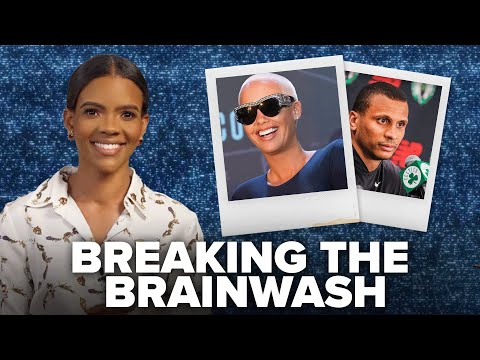
Summary of Candace Owens Podcast (Ep 3) | Uh-oh! Black Americans Can No Longer Be Controlled
Episode 3, “Uh-oh! Black Americans Can No Longer Be Controlled,” centers on Candace Owens’s claim that Black public figures are becoming less politically and culturally aligned with the Democratic Party and mainstream media. Across its 35-minute runtime, she connects Amber Rose’s Trump endorsement, Celtics coach Joe Mazzulla’s Christian statements, media criticism of Donald Trump, gun rights, celebrity culture, immigration, and Catholic faith into a broader argument about “mass brainwashing” and spiritual conflict.[youtube]
Central thesis
Owens’s overarching claim is that institutions such as mainstream media, Hollywood, government, and popular culture manipulate public beliefs—especially among Black Americans—and that this influence is weakening. She calls this process “mass psychosis,” “black magic,” and, repeatedly, a spiritual battle between good and evil.
Her conclusion is that people should reject racial, party, and celebrity-based identities in favor of faith, national cohesion, family, self-discipline, and skepticism toward institutions. This is Owens’s ideological interpretation, not a conclusion established by the episode’s examples.[youtube]
Hollywood, hip-hop, and mind control
The first major segment begins with a viewer question about the “hip-hop-to-prison pipeline”—the idea that hip-hop culture can encourage conduct that contributes to incarceration. Owens says she instead believes in a “prison-to-hip-hop pipeline.”
Her argument develops as follows:
- She says she believes the CIA has long influenced Hollywood and popular culture.
- She cites CHAOS, Tom O’Neill’s book about Charles Manson and the CIA, as reinforcing her suspicions about government involvement in cultural manipulation.
- She recounts claims associated with the Manson case: that Manson was allegedly protected by authorities, had access to LSD, and used drugs and coercion to influence followers.
- She links this history to MKUltra, the CIA’s real historical mind-control research program, and then extrapolates to a much broader belief that entertainment and media are used to shape mass behavior.
- She references accusations made by Ye/Kanye West against Sean “Diddy” Combs and mentions lawsuits and allegations involving Combs, but does not present independently verified evidence that Combs was a federal informant or that Hollywood is centrally directed by the CIA.[youtube]
Owens then argues that contemporary rap and Black popular culture are particularly degrading, violent, sexualized, or spiritually corrupting compared with the music she associates with earlier generations, such as the Temptations. She says Black audiences receive the “worst” cultural material and speculates that powerful actors are intentionally trying to corrupt Black people.
This section is the episode’s most speculative. It moves from documented historical subjects—such as CIA experimentation and the Manson-era counterculture—to expansive claims about Hollywood, Black music, celebrities, and “demonic” cultural control that are expressed as Owens’s beliefs rather than supported as demonstrated facts.
Black celebrities rejecting old roles
Owens presents two examples as evidence that Black Americans can no longer be politically managed through conventional media messaging.
Joe Mazzulla and Christianity
She praises Joe Mazzulla, the Boston Celtics head coach, for redirecting race-focused media questions toward Christianity.
- When asked about the historic significance of two Black head coaches appearing in the NBA Finals, Mazzulla responded by asking how many Christian coaches had been in the Finals.
- In a separate press exchange involving the Prince and Princess of Wales, he said he was familiar with only one royal family: Jesus, Mary, and Joseph.
Owens interprets these comments as a refusal to accept racial framing and as a public assertion of Christian faith. She sees his approach as a model for resisting what she calls media manipulation and divisive identity politics.[youtube]
Amber Rose and Donald Trump
Owens also praises Amber Rose for publicly supporting Donald Trump and for saying she had done her own research and was no longer “brainwashed by the left.”
Owens focuses on Rose’s comment that her support for women affected by domestic violence, sexual assault, and rape does not require continuing her former SlutWalk activism. Owens uses it to argue that a person can change political or cultural views without being discredited solely for earlier activism.[youtube]
Her broader point is that Black celebrities—and Black voters more generally—are beginning to reject the cultural and political roles she believes the left and entertainment industry have assigned them.
Trump, Hitler comparisons, and Rachel Maddow
Owens turns next to comments from Rachel Maddow, who expressed concern that a second Trump administration could target critics and discussed warnings about camps, political enemies, and dehumanizing rhetoric.
Owens reacts by arguing that comparisons between Trump and Adolf Hitler have become repetitive, emotionally manipulative, and unpersuasive. She says media figures invoke Nazi imagery to condition audiences to fear Trump rather than to assess his record or policies.
Her counter-framing is that the more immediate danger comes from what she calls the “deep state” and the Biden administration’s use of government institutions against political opponents, particularly Trump. She points to criminal prosecutions and other government actions involving Trump as evidence of politically motivated power.
The episode does not offer a neutral comparison of Trump’s statements, Maddow’s full argument, or the facts surrounding each prosecution. It is a strongly partisan response designed to reject the authoritarianism warning and reverse it onto Trump’s opponents.[youtube]
Biden, firearms, and preparedness
Owens plays a clip of President Biden discussing the limits of civilian firearms against the U.S. military, including his recurring point that rifles would not defeat fighter jets such as F-15s.
She treats the remark as an inadvertent admission that the government would use overwhelming force against Americans who resist it. Her main argument is that the statement gives people an additional reason—not a reason to surrender firearms—to value gun ownership.
She expands that into practical preparedness advice:
- Keep several months of cash available, in her view.
- Learn basic self-sufficiency skills, including gardening, hunting, and firearms use.
- Store emergency food and water.
- Prepare for power outages, severe weather, supply disruptions, war, or a broader breakdown of infrastructure.
This discussion transitions into a paid promotion for ReadyPantry, a seller of long-shelf-life food and water supplies. The preparedness claims and political framing are Owens’s commentary; the sponsor segment is advertising.[youtube]
Celebrity culture and faith
Owens discusses reports that Jennifer Lopez and Ben Affleck may be separating, including the cancellation of Lopez’s tour and reports regarding their real estate and living arrangements.
She says people should stop investing emotionally in celebrity relationships and “Hollywood happy endings.” She links celebrity culture to spiritual corruption, calls Hollywood “demonic,” and criticizes both Lopez and Affleck’s parenting choices relating to their children’s gender identities.
She also discusses Affleck’s publicly known history of alcohol-related struggles, arguing that faith, personal growth, family stability, and recovery should take priority over another rapid relationship. This is framed as moral and religious commentary rather than an evidence-based assessment of either person’s present circumstances.[youtube]
Immigration, culture, and Catholicism
In the listener-comment section, Owens responds to a viewer in Austria who describes concerns about immigration, language integration, welfare use, and crime.
Owens agrees with the commenter and makes several broader claims:
- Governments and elites promote “multiculturalism” not to enrich society, she argues, but to weaken national cultures and identities.
- Immigrants should learn the host country’s language, participate in its culture, work, and contribute to civic life.
- Criticism of migration policy, she says, is often incorrectly labeled racist or Nazi-like.
- A cohesive national culture is necessary for social health, while cultural division produces tension and conflict.
She places that political argument within a Catholic theological framework, referring to the idea of the devil as connected to division or separation. She then praises traditional Latin Mass as a unifying practice, recounting a pilgrimage experience in France in which people from several countries prayed together in Latin.[youtube]
Health and body-image segment
Owens concludes by responding to a listener who says they are overweight and trying to improve their health. She rejects body-positivity messaging that, in her view, normalizes unhealthy weight.
Her advice is motivational but general:
- Recognize the problem and commit to improving.
- Begin with manageable daily movement, such as increasing step counts.
- Adjust diet; she says she favors a Paleo-style approach.
- Focus on personal responsibility, persistence, and getting back on track after setbacks.
Although exercise and nutrition can support health, individual dietary and weight-management plans are best tailored with qualified medical or nutrition guidance, particularly where someone has health conditions, medication use, disability, or a history of disordered eating.[youtube]
Main takeaway
Episode 3 is not primarily a conventional news roundup. It is a worldview-driven culture-and-politics monologue in which Owens treats celebrity behavior, media messaging, race politics, gun rights, immigration, and religion as connected parts of a single struggle.
Her intended message is that Black Americans, Christians, and other Americans should reject what she considers elite-controlled narratives; stop defining themselves through race, party, or celebrity culture; strengthen family and faith; preserve gun rights and personal preparedness; and resist institutions she views as divisive or manipulative. The episode’s descriptions of CIA-Hollywood control, coordinated cultural “brainwashing,” and spiritual/demonic influence are presented as Owens’s convictions and should not be mistaken for independently substantiated findings.[youtube]